WBGT (Wet Bulb Globe Temperature) measures heat stress by combining air temperature, humidity, radiant heat, and airflow. Understanding what is wbgt is crucial for assessing heat stress accurately. When exploring what is wbgt, it becomes evident that this measurement is vital for safety.
Unlike a standard thermometer reading, WBGT provides an accurate composite index representing the true environmental load on the human body. The standard mathematical formula used to calculate outdoor WBGT is:
WBGT = 0.7Tw + 0.2Tg + 0.1Td
For anyone asking what is wbgt, the relevance of this index cannot be overstated. Knowing what is wbgt helps in developing appropriate safety measures. This knowledge of what is wbgt plays a key role in mitigating heat stress.
Where Tw is the natural wet-bulb temperature (representing evaporative cooling), Tg is the globe temperature (representing radiant heat), and Td is the standard dry-bulb air temperature.
Why WBGT Matters?
WBGT (Wet Bulb Globe Temperature) matters because it provides a comprehensive measure of heat stress in direct sunlight, accounting for temperature, humidity, wind speed, and solar radiation. It helps in assessing risk levels for heat-related illnesses in outdoor workers and athletes, guiding safety protocols and preventive measures.
Understanding What is WBGT and Its Importance
To fully grasp what is wbgt, one must consider its effects on human health. Understanding what is wbgt is essential for outdoor laborers.
As global temperatures continue to break records, measuring environmental conditions accurately is vital for operational safety. Relying solely on ambient air temperature is dangerously deceptive, especially when relative humidity levels are high. In climates like Singapore, knowing what is wbgt can save lives.
Those involved in safety should be well-versed in what is wbgt.
Workplace Safety: High environmental heat load reduces cognitive function, slows down reaction times, and drastically increases the frequency of workplace accidents.
Heat Exhaustion Prevention: Monitoring WBGT levels allows safety officers to implement timely rest schedules, hydration intervals, and cooling measures before workers succumb to heat cramps, heat exhaustion, or fatal heat strokes.
Construction Monitoring: Construction sites feature heavy manual labor, protective gear, and reflective surfaces that amplify ambient heat. Real-time tracking keeps projects safe and active.
Outdoor Worker Protection: For individuals exposed to direct sunlight and high physical exertion, WBGT acts as an objective, data-driven guardrail to dictate safe work-to-rest ratios.
The Singapore Context: Climate and Heat Stress Risk
Situated just one degree north of the equator, Singapore features a distinct tropical climate characterized by uniform temperatures and persistently high relative humidity (often exceeding 80%). This combination creates severe heat stress risks. When humidity is extremely high, the human body cannot efficiently evaporate sweat to cool down. Because of this localized climate profile, tracking WBGT is an absolute necessity for anyone managing operations in Singapore to keep personnel safe and environments productive.
To understand how a WBGT meter arrives at its safety index, it is important to break down the three distinct temperature inputs measured by specialized sensor components:
Wet Bulb Temperature (Tw): Measured by a thermometer wrapped in a water-saturated wick exposed to natural airflow. This parameter simulates how effectively the human body can cool itself via sweating. High ambient humidity prevents evaporation, causing the wet bulb temperature to stay close to the air temperature.
Globe Temperature (Tg): Measured by a sensor placed inside a matte black copper sphere. This component absorbs direct solar radiation and radiant heat emitted by surrounding hot surfaces like asphalt, concrete structures, or heavy industrial machinery.
Dry Bulb Temperature (Td): This is the standard ambient air temperature measured by a thermometer shielded from direct sunlight and radiant heat sources.
WBGT Applications
Various industrial sectors utilize WBGT metrics to safeguard human assets and maintain regulatory compliance:
Construction: Sites use portable or fixed WBGT monitors to determine mandatory shaded rest breaks and hydration schedules for laborers operating under direct sunlight.
Shipyards: Workers in shipyards often operate inside tightly enclosed, poorly ventilated steel hulls that trap radiant heat, making continuous WBGT logging critical.
Manufacturing: Heavy manufacturing, glass production, and foundries use interior WBGT indices to monitor environments with large, heat-generating machinery.
Military: Armed forces use the index to dictate the intensity of physical training, field exercises, and marches, preventing heat casualties during intense drills.
Logistics: Ground handlers, outdoor loading dock staff, and warehouse workers operating under zinc roofing depend on automated tracking to prevent heat exhaustion.
Singapore Heat Stress Management
Different industries rely heavily on what is wbgt to ensure worker safety. In Singapore, the Ministry of Manpower (MOM) requires employers to monitor the Wet Bulb Globe Globe Temperature (WBGT) every hours during outdoor work hours. This ensures workplaces can implement dynamic work-rest cycles, maintain hydration, and prevent heat-related illnesses.
In response to rising temperatures, Singapore’s regulatory framework has formalized heat stress tracking to mandate safer working conditions.
MOM Heat Stress Management: The Ministry of Manpower (MOM) has established clear guidelines for managing heat stress in workplaces. Employers are required to conduct risk assessments and monitor heat levels to implement proper administrative and engineering controls.
Workplace Monitoring: Companies must deploy accurate tracking mechanisms—such as calibrated onsite WBGT meters—especially when workers are exposed to strenuous manual labor or outdoor conditions.
Outdoor Safety: MOM’s framework utilizes WBGT thresholds to trigger mandatory action steps, such as shifting heavy work to cooler times of day, providing shaded rest areas, and establishing structured buddy systems to monitor for early signs of heat-induced distress.
Recommended WBGT Meters
Building a compliant heat stress safety program requires industrial-grade, precision-calibrated testing instruments. Explore our professional monitoring range:
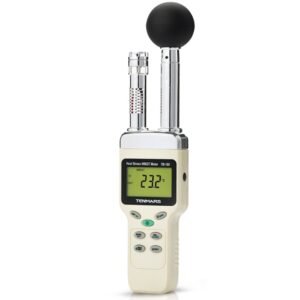
Tenmars TM-188 WBGT Meters & Heat Stress Monitors: Browse our comprehensive range of high-precision portable WBGT meters, stationary data-logging systems, and wireless environmental monitoring setups engineered to meet stringent international standards and MOM compliance criteria.
FAQs
What sensors are used?
An industrial WBGT meter uses a specialized three-sensor array consisting of a capacitive or thermistor ambient air sensor (dry bulb), a natural wet bulb sensor utilizing a distilled water reservoir/wick, and a high-accuracy black globe temperature sensor. Regulatory bodies emphasize the importance of understanding what is wbgt.
Can monitoring be remote?
Yes. Modern smart WBGT monitoring systems integrate IoT connectivity, allowing sensors to upload data continuously to a cloud dashboard. This enables safety officers to monitor real-time heat stress indices across multiple remote work sites from a single smartphone or desktop control center. Additionally, the community should educate themselves on what is wbgt. Workers must also be aware of what is wbgt to protect themselves.
What is LoRa monitoring?
LoRa (Long Range) monitoring uses a low-power, wide-area RF network technology. It allows wireless WBGT meters deployed across expansive outdoor job sites, shipyards, or deep industrial facilities to transmit their data back to a central gateway without high battery drain, ensuring years of uninterrupted autonomous operation.
Investing in tools that measure what is wbgt is crucial for compliance. In summary, knowing what is wbgt can enhance safety protocols. Thus, understanding what is wbgt becomes a priority for many organizations.
UbiBot IoT System Deployed for Wind Turbine Feasibility Study We’re thrilled to announce the successful installation and setup of a cutting-edge UbiBot IoT system on the rooftop of our building, strategically positioned near the helicopter landing pad. This exciting development…
Real-Time Temperature Monitoring Using UbiBot GS1-A1RS-1DS Maintaining the integrity of the cold chain is paramount for businesses dealing with temperature-sensitive goods. Any deviation from the required temperature range can lead to spoilage, product loss, and potential health hazards. At GMM…