WBGT is more accurate than Heat Index for workplace safety because it includes radiant heat and airflow in addition to temperature and humidity. When comparing WBGT vs Heat Index, it’s important to consider the specific conditions of your environment.
What is Heat Index?
The Heat Index, also known as the apparent temperature, is a measure that combines air temperature and relative humidity to represent how hot it feels to the human body. It is often used in weather reports to indicate the risk of heat-related illnesses.
Understanding the distinctions between WBGT vs Heat Index can greatly affect safety protocols. The relevance of WBGT vs Heat Index increases in high-temperature workplaces.
The Heat Index, often referred to as the “apparent temperature” or the “feels-like” temperature, is a metric that combines ambient air temperature and relative humidity. Its primary purpose is to determine how hot the air feels to a human body when exposed in a shaded area.
For many industries, choosing between WBGT vs Heat Index is crucial for maintaining safety standards.
Because the Heat Index assumes a person is resting in a shady location with a light breeze, it does not factor in the intense effects of direct sunlight, moving air currents, or radiant heat bouncing off industrial surfaces. This makes it a useful metric for general public weather reports, but highly limited for active industrial worksites.
What is WBGT?
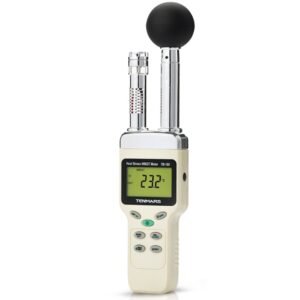
Wet Bulb Globe Temperature (WBGT) is a comprehensive environmental metric designed to evaluate the true heat stress load on an active individual. Unlike the Heat Index, WBGT takes a multi-sensor approach to measure the environment. It integrates ambient air temperature and relative humidity with two additional critical factors: radiant heat (such as direct sunlight or machinery warmth) and wind speed / airflow.
In summary, the debate of WBGT vs Heat Index impacts overall workplace safety. By accounting for these extra variables, WBGT offers an objective measure of thermal stress, helping safety officers prevent heat exhaustion in workplaces. For a deep dive into how these factors are mathematically calculated, read our complete WBGT Guide.
Comparison Table
Understanding WBGT vs Heat Index helps businesses prepare for heat-related challenges. Ultimately, the choice of WBGT vs Heat Index should align with industry-specific needs. This crucial understanding of WBGT vs Heat Index can enhance safety in high-risk environments. Understanding the technical boundaries between these two environmental measurements is crucial for selecting the right workplace safety tool. The table below highlights the key functional differences:
By comprehending WBGT vs Heat Index, companies can implement effective heat stress management.
Feature
WBGT
Heat Index
Humidity
Yes (Measured via natural wet bulb)
Yes (Calculated mathematically)
Air Temperature
Yes (Measured via shielded dry bulb)
Yes (Standard thermometer reading)
Radiant Heat
Yes (Measured via black globe sensor)
No (Assumes shaded conditions)
Workplace Safety
Excellent (Meets MOM/OSHA industrial criteria)
Limited (Fails to capture raw outdoor solar load)
Investing in the right tools for measuring WBGT vs Heat Index is a proactive approach to health.
Which is Better for Singapore?
When evaluating workplace safety parameters within Singapore, WBGT is unequivocally the superior and recommended standard.
Singapore features a distinct tropical climate marked by high ambient temperatures, relentless solar radiation, and persistently elevated relative humidity levels that frequently hover above 80%. In an outdoor setting—such as a construction site, shipyard, or landscaping project—workers are exposed to direct sunlight and intense radiant heat reflecting off concrete slabs, asphalt roads, and steel infrastructure.
Because the Heat Index completely ignores radiant heat and assumes the worker is in the shade, relying on it in Singapore can create a dangerous blind spot. It can significantly underestimate the actual thermal stress on labor forces. Deploying onsite WBGT monitors ensures compliance with the Ministry of Manpower (MOM) heat stress management framework, protecting outdoor work forces from severe heat-related illnesses.
Understanding WBGT vs Heat Index
Relying solely on the Heat Index, rather than comparing it to WBGT vs Heat Index, can lead to safety oversights.
Maintaining a compliant and accurate heat stress tracking program requires industrial-grade, certified instrumentation. Explore our targeted professional gear:
Tenmars TM-188 Heat Stress & WBGT Meters: Browse our comprehensive collection of precision handheld WBGT meters, stationary data-logging units, and wireless IoT heat monitoring setups engineered to deliver real-time safety metrics across harsh industrial environments.
FAQs
Is WBGT more accurate?
Yes, WBGT is substantially more accurate than the Heat Index for industrial safety applications. By physically measuring radiant heat and environmental airflow alongside temperature and humidity, it evaluates the true composite thermal load acting on the human body, rather than relying on a shaded “feels-like” estimate.
Why does WBGT matter outdoors?
Outdoors, workers are subjected to direct solar radiation and convective heat moving through air currents. WBGT utilizes a specialized matte black globe sensor that actively absorbs this radiant energy, simulating how a worker’s body absorbs heat while operating under an open sun.
Is Heat Index enough for workplace safety?
Generally, no. While the Heat Index is suitable for residential or indoor office comfort assessments, it is insufficient for heavy industrial environments, construction zones, or outdoor operations. It lacks the capability to measure radiant heat and airflow, both of which are critical for preventing severe heat stroke and ensuring compliance with MOM guidelines.
Thrilling adventures await at the soon-to-open Rainforest Wild Asia, and GMM Technoworld is proud to play a crucial role in ensuring the safety of all thrill-seekers. We’ve just completed the successful testing and commissioning of our state-of-the-art Navis wireless anemometer…
UbiBot GS1 and the Future of Farming Soil Monitoring Precision agriculture is no longer a futuristic concept; it’s a necessity for modern farmers seeking to maximize yields and optimize resource utilization. At the heart of this agricultural revolution lies the…